


Volume List View
Overview
The volume information is displayed in list form.
Screenshots
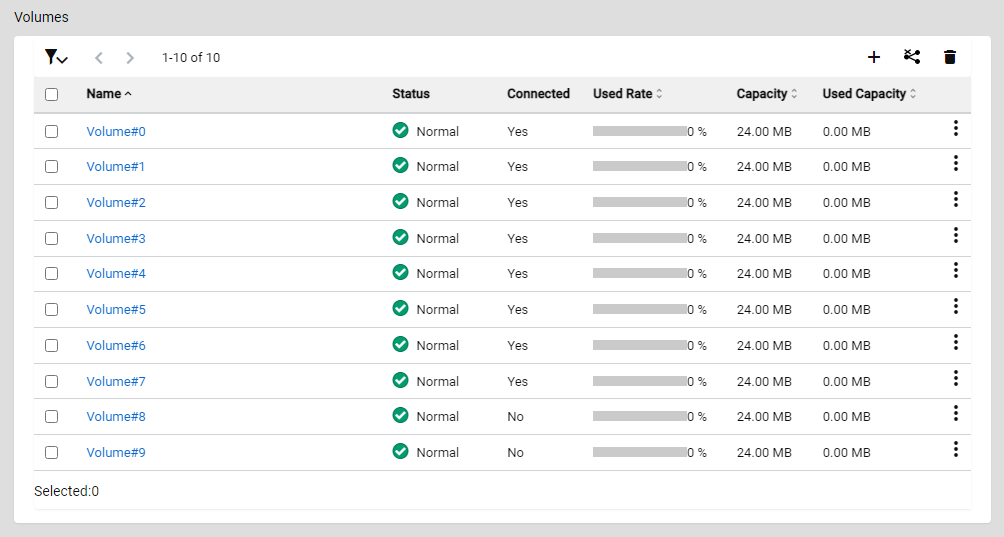
Actions
| Icon/Button | Description |
|---|---|
 |
Opens/closes the filter menu. Click this icon to open the filter menu to filter the display items and display resources of the list. Click this icon again to close the filter menu. The filter menu is closed by default. |
< > X - Y of Z |
Changes the List page. Click the left arrow icon to return to the previous page. Click the right arrow icon to proceed to the next page. The location of the currently displayed resource and the total number of resources are also displayed. X: The start point of the currently displayed list element. Y: The end point of the currently displayed list element. Z: The total number of elements. |
 |
Creates new volumes. Click this icon to open the dialog to create new volumes. |
 |
Disconnects the connections from all the hosts to the volume. Click this icon to open the dialog for disconnecting the connections from all the hosts to the selected volume. |
 |
Deletes volumes. Click this icon to open the dialog to delete the selected volumes. |
 |
Opens/closes the action menu of the volume. Click this icon to open a menu for the various operations that can be performed for the volume.
|
Setting Items
| Name | Description |
|---|---|
 |
Select the volume that is to be disconnected from the host or to be deleted. |
Display Items
| Parameter Name | Description |
|---|---|
Name |
The volume name is displayed. Click a volume name to display its Detail View. |
Status |
The volume status is displayed.
|
Connected |
Whether the volume is connected from a host is displayed.
|
Used Rate |
The usage rate of the volume is displayed. The ratio of the physically allocated capacity to the volume capacity is displayed in a band chart. In addition, the used rate (%) is displayed next to the band chart. Information
|
Capacity |
The volume capacity is displayed. The capacity is displayed up to the second decimal place with the appropriate "MB", "GB", "TB", or "PB" unit. |
Used Capacity |
The physically allocated capacity of volume is displayed. The capacity is displayed up to the second decimal place with the appropriate "MB", "GB", "TB", or "PB" unit. Information
|
Volume No. |
The volume number is displayed. The volume identifier that is used for systems such as Web GUI (Normal View) and CLI. |
Type |
The volume type is displayed.
|
Usage |
The usage of the volume is displayed.
|
Detailed Status |
The detailed status of the volume is displayed.
|
UID |
The Universal Identifier (UID) of the volume is displayed. The UID is an identifier (device name) to specify a volume from the host. |
EXC |
Whether the volume is an Extreme Cache target volume or an Extreme Cache Pool target volume is displayed.
|
Compression |
Whether the Compression function is enabled is displayed.
|
Deduplication |
Whether the Deduplication function is enabled is displayed.
|
Location |
The name of the Thin Provisioning Pool, Flexible Tier Pool, or RAID group where the volume belongs is displayed.
For Thin Provisioning Pools, click a pool name to display its Detail View. |
Selected: x |
The number of selected volumes is displayed. |
Filters
| Parameter Name | Description |
|---|---|
Default Settings |
Reverts the filter menu setting to the default. |
Items per page |
Select the number of resources to display per page in the list. The default number is 20.
|
Name |
Specify the name of the volume to be displayed in the list. Information of the volume whose name partially matches the input string is displayed. If no values are specified, the list will not be filtered by volume name. This item is blank by default. Information
|
Status |
Select whether to display the "Status" column in the list. The "Status" column is displayed by default. This item is also used to select the status of the volume that is to be displayed in the list. The volumes that are in the selected status are displayed in the list. If no volume statuses are selected, the list will not be filtered by volume status. No volume statuses are selected by default.
|
Connected |
Select whether to display the "Connected" column in the list. The "Connected" column is displayed by default. This item is also used to select the connection status of the volume that is to be displayed in the list. The volumes that are in the selected connection status are displayed in the list. If no volume connection statuses are selected, the list will not be filtered by volume connection status. No volume connection statuses are selected by default.
|
Used Rate |
Select whether to display the "Used Rate" column in the list. The "Used Rate" column is displayed by default. This item is also used to specify the Used Rate threshold of the volume that is to be displayed in the list. Volumes that meet the specified threshold and condition are displayed. The input unit is "%". If no values are specified, the list will not be filtered by used rate. This item is blank by default. Information
|
Capacity |
Select whether to display the "Capacity" column in the list. The "Capacity" column is displayed by default. This item is also used to specify the Capacity threshold of the volume that is to be displayed in the list. Volumes that meet the specified threshold and condition are displayed. The input unit is "MB", "GB", "TB", or "PB". If no values are specified, the list will not be filtered by volume capacity. This item is blank by default. Information
|
Used Capacity |
Select whether to display the "Used Capacity" column in the list. The "Used Capacity" column is not displayed by default. This item is also used to specify the Used Capacity threshold of the volume that is to be displayed in the list. Volumes that meet the specified threshold and condition are displayed. The input unit is "MB", "GB", "TB", or "PB". If no values are specified, the list will not be filtered by physically allocated capacity of volume. This item is blank by default. Information
|
Volume No. |
Select whether to display the "Volume No." column in the list. The "Volume No." column is not displayed by default. This item is also used to specify the volume number threshold of the volume that is to be displayed in the list. Volumes that meet the specified threshold and condition are displayed. If no values are specified, the list will not be filtered by volume number. This item is blank by default. Information
|
Type |
Select whether to display the "Type" column in the list. The "Type" column is not displayed by default. |
Usage |
Select whether to display the "Usage" column in the list. The "Usage" column is not displayed by default. |
Detailed Status |
Select whether to display the "Detailed Status" column in the list. The "Detailed Status" column is not displayed by default. |
UID |
Select whether to display the "UID" column in the list. The "UID" column is not displayed by default. |
EXC |
Select whether to display the "EXC" column in the list. The "EXC" column is not displayed by default. This item is also used to select the setting status of Extreme Cache (or Extreme Cache Pool) for the volume that is to be displayed in the list. Volumes that meet the specified setting status of Extreme Cache (or Extreme Cache Pool) are displayed. If no statuses of Extreme Cache (or Extreme Cache Pool) are selected, the list will not be filtered by the Extreme Cache (or Extreme Cache Pool) setting status. The setting status of Extreme Cache (or Extreme Cache Pool) is not selected by default.
|
Compression |
Select whether to display the "Compression" column in the list. The "Compression" column is not displayed by default. This item is also used to select the Compression setting status of the volume that is to be displayed in the list. The volumes that are in the selected Compression setting status are displayed in the list. If no Compression setting statuses are selected, the list will not be filtered by Compression setting status. The Compression setting status is not selected by default.
|
Deduplication |
Select whether to display the "Deduplication" column in the list. The "Deduplication" column is not displayed by default. This item is also used to select the Deduplication setting status of the volume that is to be displayed in the list. The volumes that are in the selected Deduplication setting status are displayed in the list. If no Deduplication setting statuses are selected, the list will not be filtered by Deduplication setting status. The Deduplication setting status is not selected by default.
|
Location |
Select whether to display the "Location" column in the list. The "Location" column is not displayed by default. Specify the resource name of the volume to be displayed in the list. Information of the volume in the location that partially matches the input string is displayed. If no values are specified, the list will not be filtered by location. This item is blank by default. Information
|