


Data Block Guard
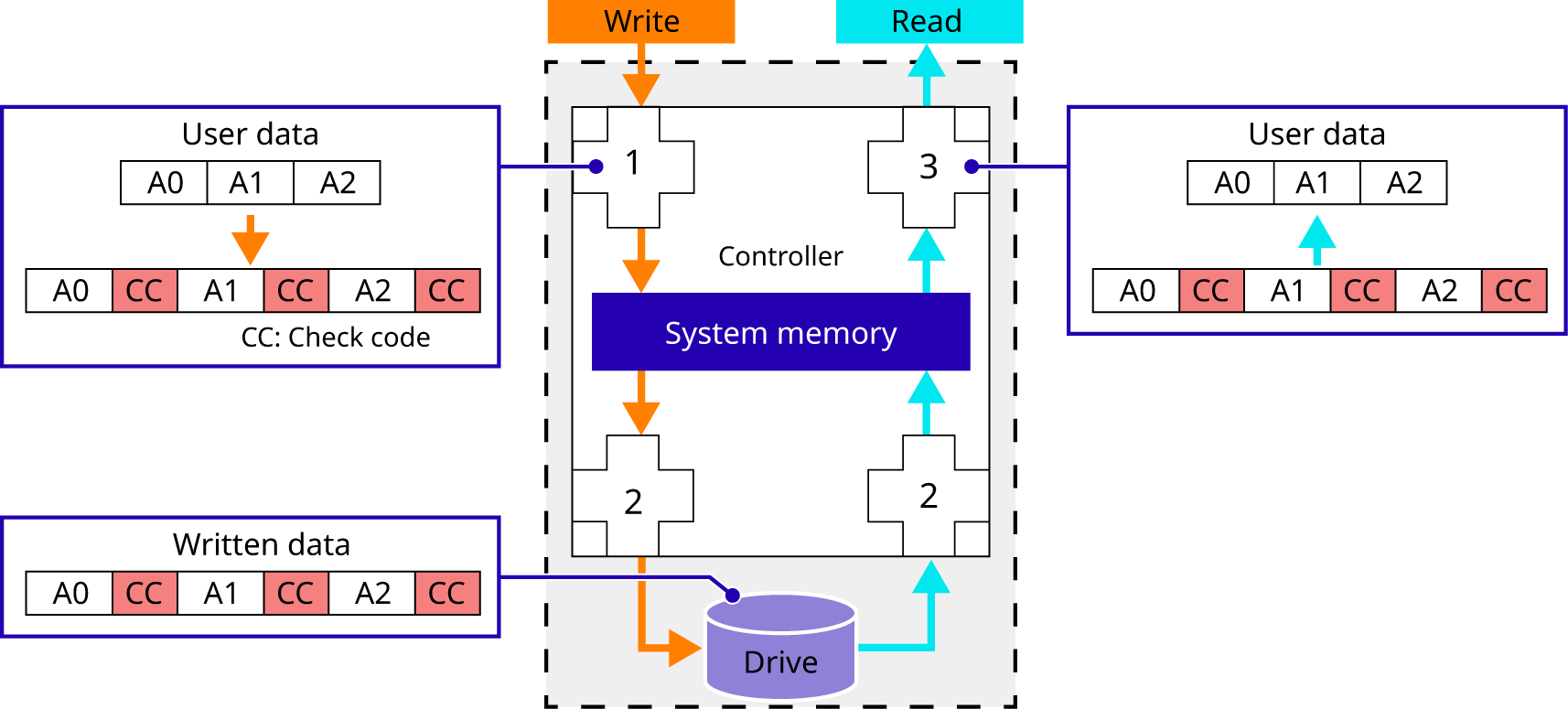
When a write request is issued by a server, the data block guard function adds check codes to all of the data that is to be stored. The data is verified at multiple checkpoints on the transmission paths to ensure data integrity.
When data is written from the server, the Data Block Guard function adds eight bytes check codes to each block (every 512 bytes) of the data and verifies the data at multiple checkpoints to ensure data consistency. This function can detect a data error when data is destroyed or data corruption occurs. When data is read from the server, the check codes are confirmed and then removed, ensuring that data consistency is verified in the whole ETERNUS DX.
If an error is detected while data is being written to a drive, the data is read again from the data that is duplicated in the system memory. This data is checked for consistency and then written.
If an error is detected while data is being read from a drive, the data is restored using RAID redundancy.
1. |
The check codes are added |
2. |
The check codes are confirmed |
3. |
The check codes are confirmed and removed |
Also, the T10-Data Integrity Field (T10-DIF) function is supported. T10-DIF is a function that adds a check code to data that is to be transferred between the Oracle Linux server and the ETERNUS DX, and ensures data integrity at the SCSI level.
The server generates a check code for the user data in the host bus adapter (HBA), and verifies the check code when reading data in order to ensure data integrity.
The ETERNUS DX double-checks data by using the data block guard function and by using T10-DIF to improve reliability.
Data is protected at the SCSI level on the path to the server. Therefore, data integrity can be ensured even if data is corrupted during a check code reassignment.
By linking the Data Integrity Extensions (DIX) function of Oracle DB, data integrity can be ensured in the entire system including the server.
The T10-DIF function can be used when connecting with HBAs that support T10-DIF with an FC interface.
The T10-DIF function can be enabled or disabled for each volume when the volumes are created. This function cannot be enabled or disabled after a volume has been created.
The T10-DIF function can be enabled only in the Standard volume.
LUN Concatenation cannot be performed for volumes where the T10-DIF function is enabled.