


Multipath Configuration
A multipath configuration connects the ETERNUS DX to a server via multiple paths (multipath). System reliability is improved due to the path redundancy.
If a path fails, access can continue by using the path failover function that switches access from the failed path to another path.
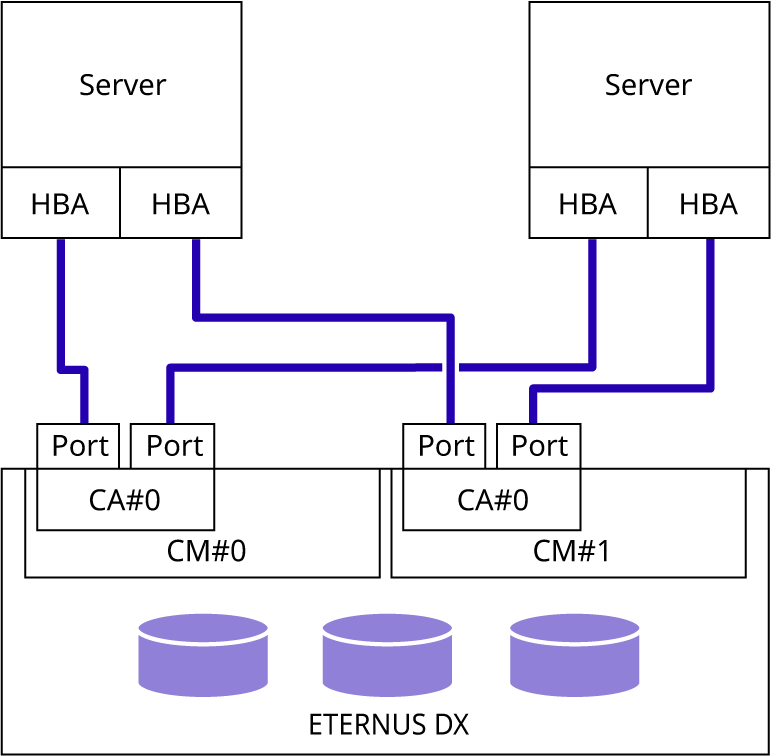
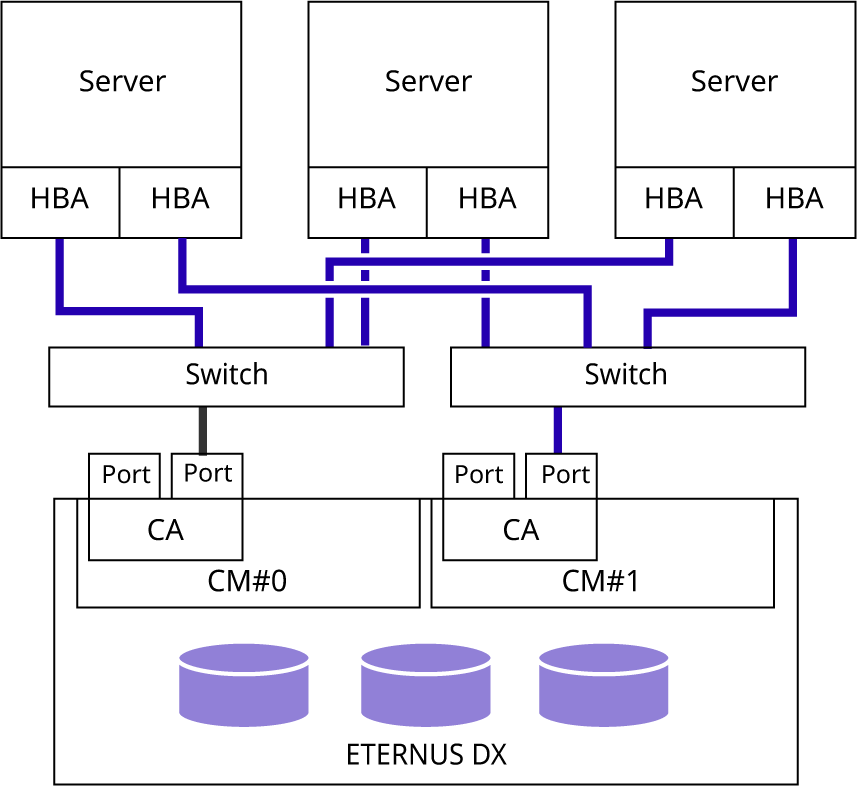
When the ETERNUS DX is accessed from both of the servers, performance can be secured by connecting to the ETERNUS DX using one host interface port on each of the four host interfaces.
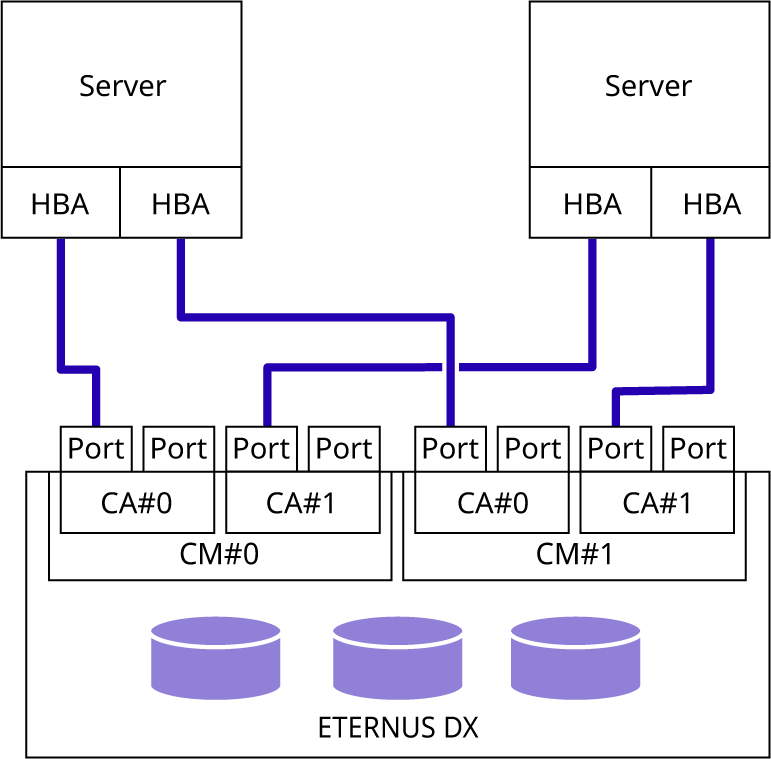
When configuring multipathing for reliability, make sure to configure a redundant connection for the controllers of the ETERNUS DX. Configure paths to connect to different controllers (CM#0 and CM#1). Combinations of host interface numbers (CA#0 and CA#1) in controllers do not need to be taken into consideration.
Paths from a single server should be separately connected to a different host interface in case of host interface failure.
If two or more controller enclosures are installed, using a crossover connection for the controller enclosures improves the reliability. Note that when connecting controller enclosures with a crossover connection, connecting to controllers on different connection lines (CE#0 CM#0 and CE#1 CM#1, and CE#0 CM#1 and CE#1 CM#0) is required.
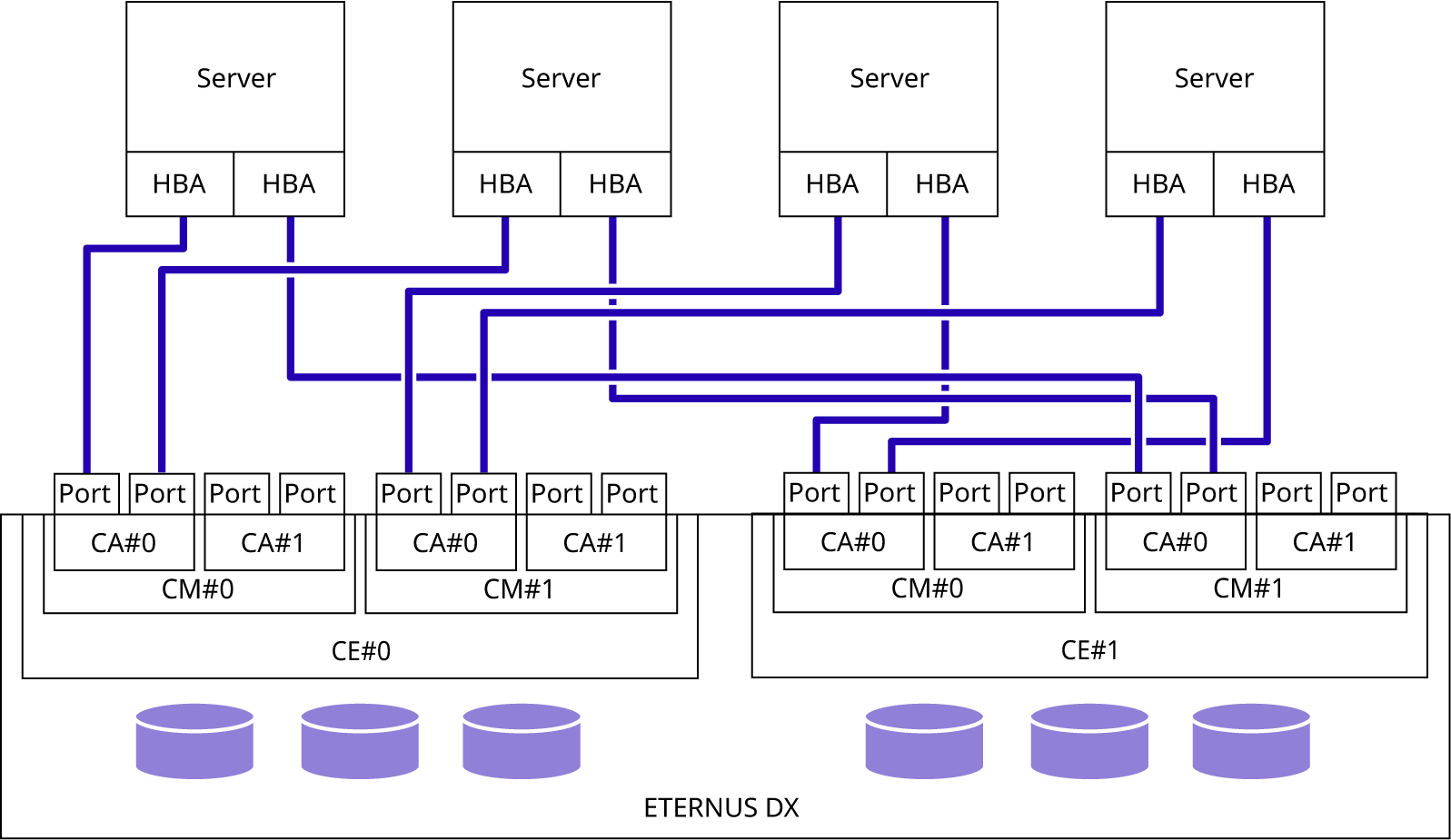
When using a multipath connection, the combinations of host interface numbers (CA#0 and CA#1) in the controllers or the combinations of controller enclosure numbers do not need to be taken into consideration.
During a hot update of the controller firmware, because the controllers in the same system (such as CE#0 CM#0 and CE#1 CM#0) are rebooted, connecting to controllers on a different system (such as CE#0 CM#0 and CE#1 CM#1, and CE#0 CM#1 and CE#1 CM#0) is required.